
I recently did a podcast interview on the Future Force Talk podcast, which is hosted by the Hungarian Defence Ministry’s Defence Innovation Research Institute (in Hungarian: Védelmi Innovációs Kutató Intézet, which has the wonderful acronym VIKI). The podcast host is Dr Gergely Németh, the Director of VIKI, who was formerly the Branch Head of the Strategic Foresight Branch at NATO’s Allied Command Transformation.
Two recent activities – a podcast and a presentation
I see that it has been quite a while since I posted here. This is mainly because for the past year or so, and most especially the last six months, I have been immersed up to my eyelobes [sic] in the International Relations literature working on a thematic paper on the future of the rules-based international order. I’ll delay any further discussion about this until the paper is published and then reflect on what that was like. But you can probably guess from the previous blog entry who this was for…
Continue reading “Two recent activities – a podcast and a presentation”
NATO’s First Allied Foresight Conference
Last week, I was invited to attend and present at the First Allied Foresight Conference, organised by NATO’s Allied Command Transformation in conjunction with the Finnish Ministry of Defence. This follows a very successful Foresight Symposium held in Washington DC around this time last year.
NATO’s Strategic Foresight Analysis 2023
Last year I contributed to the development of the Strategic Foresight Analysis 2023 (SFA23), undertaken by the Strategic Foresight Branch of NATO’s Allied Command Transformation. This was a more-than-year-long effort combining the expertise of some 800 workshop participants, together with the experience of around 20 or so members of a core reference team who got to see, comment upon, and make suggestions for inclusion into, earlier draft versions of the Report (see page 98 of the SFA23 to see their names). It was amazing to see the document take shape over that time.
Continue reading “NATO’s Strategic Foresight Analysis 2023”
Scanning hits over at LinkedIn
In the spirit of the Scanning Retrospective, I now publish some of my scanning hits over at LinkedIn, on a dedicated page called, of course (what else?), TheVoroscope. I typically post only 2-3 per week, and then only if they are something that catches my eye, so if you look through the hits from the Scanning Retrospective and you find them interesting or quirky enough, or they seem to resonate for you, you might want to consider “following” TheVoroscope page over at LinkedIn.
https://www.linkedin.com/company/thevoroscope/
National Security Podcast episode – Mapping the Future
A few weeks ago I was in Canberra to teach into the Advanced Futures course run by the Futures Hub at the National Security College (NSC), which is part of a joint initiative between the Australian Commonwealth Government and The Australian National University (ANU).
This was my third trip to NSC, so – according to the Goldfinger Principle – this now constitutes “enemy action” 😉
I taught into the opening morning session and, later that afternoon, took part in recording an episode for the National Security Podcast. The two other guests were Dr Ryan Young, the Director of Research & Methods at the Futures Hub, and Odette Meli, a fellow member of the NSC’s Futures Council. We were hosted by Dayle Stanley, the Director of Strategy & Engagement for NSC. The topic was: “Mapping the future: how strategic foresight can supercharge policymaking.”
It was a wide-ranging discussion, covering a lot of territory, and was focused primarily on helping people who may not be familiar with futures analysis understand how futures can be useful in their strategic, policy and decision-making contexts. We were asked to give concrete examples of how our work has been useful, and it was very interesting to hear the other guests’ experiences – very often we carry out our foresight engagements in isolation from other practitioners, so hearing from others about their work is always fascinating and valuable.
As ever, I hope it is both interesting and useful.
https://play.acast.com/s/the-national-security-podcast/mapping-the-future/
AusCERT Podcast interview – What Does The Future Hold?
While at the AusCERT Conference back in May, I recorded a podcast interview with my old friend, tech aficionado and general tech fan-boy all-rounder Anthony Caruana. We’ve known each other for nearly 30 years, and our paths have criss-crossed many times over the course of our careers, so it was kind of fun to catch up once again for a chat.
As you might imagine, Anthony and I did a fair bit of reminiscing before the microphone went live, some of which is made reference to (but a lot is not!). The interview was recorded over lunch a couple of hours before my keynote preso later that afternoon, and actually went on for much longer, too, but the miracle of editing (and AI-powered software?) makes both of us sound fairly eloquent. It’s now published on the AusCERT web site as well as via the usual suspects channels. AusCERT call their podcast “Share Today, Save Tomorrow”, and this episode – number 25 – is entitled What Does the Future Hold?
As ever, I hope it is both interesting and useful.
https://auscert.org.au/podcast/podcast-ep-25-what-does-the-future-hold/
Conference Keynote: The future as an ever-evolving attack surface
I was invited to speak last week at the annual cybersecurity conference hosted by AusCERT, at The Star Hotel on the Gold Coast. The conference theme was “Back to the Future”, and the topic I chose was ‘The Future as an Ever-Evolving Attack Surface’, which I thought might be interesting enough to hold the many-ways-divided attention of the assembled crowd of very busy cyberfolks. And the feedback does seem to have borne this out, I’m pleased to say.
The MC for the event was Adam Spencer, and it was a good deal of fun to relate to him over breakfast the following story I used to tell my students in the Masters program (see under the de Bono Principle on the scanning heuristics page).
Continue reading “Conference Keynote: The future as an ever-evolving attack surface”
The Semi-Symmetric Metric Connection – Part IV
General Relativity
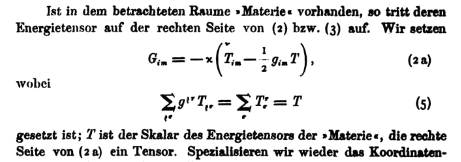
With the underlying geometry of the space defined by the semi-symmetric metric connection (SSMC) having been explored, we’re now in a position to examine how Einstein derived his field equations for GR. We will be seeking to follow similar physically-motivated reasoning, such as he used for GR, in our search for candidate field equations which might add electromagnetism to GR based on the geometrical properties of the SSMC. Continue reading “The Semi-Symmetric Metric Connection – Part IV”
Podcast for Inquiry interview
I recently recorded a podcast episode with Leslie Rosenblood of the Centre for Inquiry Canada, which produces the (aptly-named) Podcast for Inquiry.
Leslie has a wonderful ability to take conversations in new directions on the spur-of-the-moment. You can hear this in his other interviews, and in the way this one branched out several times. And also in how it tried to finish but couldn’t quite do so, the first time, no doubt due to my worrying that I had forgotten something I’d meant to speak about (the Sept 11 story).
Anyway, it was fun to do, and I hope that readers of this blog might find it useful. Sometimes it is much easier to hear someone speak about their subject than to simply read it. I hope you enjoy it.
https://centreforinquiry.ca/futures-studies-with-joseph-voros/
‘The Sum Total of All Human Knowledge’, Part VI
Implementing the schema
In this post, we look more closely at how to implement the combined and refined OoK+UDC schema using physical note-cards. These will include both the standard note-bearing cards (zettels), as well as ancillary ‘structure’ cards which are used to organise and ‘situate’ the note-bearing cards within the overall knowledge structure defined by the OoK+UDC schema.
Continue reading “‘The Sum Total of All Human Knowledge’, Part VI”
‘The Sum Total of All Human Knowledge’, Part V
Extending the schema
In this post we continue the process of refining the knowledge indexing schema based upon the Outline of Knowledge (OoK) and the Universal Decimal Classification (UDC), by now adding new categories to the framework through both combination and extension. This will bring the schema into a workable quasi-final form ready to be implemented.
Continue reading “‘The Sum Total of All Human Knowledge’, Part V”
‘The Sum Total of All Human Knowledge’, Part IV
Refining the schema
In the previous post in this series, we had arrived at the possibility of utilising a rigorous alphanumerical schema for indexing human knowledge based upon the temporal sequencing of the time-line of Cosmic Evolution and the through-line of Big History. This sequence was originally considered (Part I) as the most natural way to index knowledge disciplines, as it is both intuitively powerful (Part II), and based on the quasi-objective observable parameter of rising complexity over the course of cosmic time. Here we shall start to flesh out and fill in that indexing with an actual numerical scheme, based upon the final choice (Part III) of a combination of the Outline of Knowledge (OoK) from Encyclopedia Britannica (Adler 1994), and the Universal Decimal Classification (UDC) (UDC Consortium 2022).
Continue reading “‘The Sum Total of All Human Knowledge’, Part IV”
‘The Sum Total of All Human Knowledge’, Part III
Finding a schema
The quest to find a systematic knowledge organising schema—roughly aligned with the Cosmic Evolution timeline or Big History through-line—arose from the idea to go ‘full Zettelkasten’ on the many hundreds of notes I’ve accumulated over the years that are scattered about in various notebooks, electronic and physical, and scraps of paper filed in manilla folders languishing in various filing cabinet drawers. This is not only a useful and fun way to exercise one’s mind to try to keep it active, but is also a quite interesting exploratory research project to see just how far this wonderfully preposterous idea can be pushed. And it might even be of use to anyone else looking to use the Zettelkasten method for organising their research notes along the general lines being described in this series.
Continue reading “‘The Sum Total of All Human Knowledge’, Part III”
‘The Sum Total of All Human Knowledge’, Part II
Scoping the territory
In the previous post in this series, we saw how the astronomer Carl Sagan outlined the process of “15 billion years of Cosmic Evolution” in the final episode of the TV series Cosmos (1980). He referred to our “tracing that long path” by which the “star stuff” of which we are made eventually arose to consciousness here on the Planet Earth, and how we have now begun “contemplating the stars” and to “wonder about our origins”. Elsewhere—indeed, in the opening segment of the very first episode of Cosmos—he observed that “we are a way for the Cosmos to know itself”. And it is to that Cosmos and our quest to make sense of and organise our knowledge about it, that we now turn.
Continue reading “‘The Sum Total of All Human Knowledge’, Part II”
‘The Sum Total of All Human Knowledge’, Part I
Finding our place in space and time
As noted in the earlier post describing heuristic principles for scanning, for most of the run of the Master of Strategic Foresight at Swinburne we used to say—to new students starting in the first unit—that Futures Studies begins with ‘the sum total of all human knowledge’ (Hayward, Voros, and Morrow 2012, p184), before it then asks, whether implicitly or explicitly: “now what?” It would therefore seem to make sense, then, to have some way of organising the sum total of all human knowledge into some sort of more-or-less coherent schema, in order that one might begin to get to grips with what is, after all, merely the starting point of the vast multidisciplinary field of Futures Studies (FS).
Continue reading “‘The Sum Total of All Human Knowledge’, Part I”
Scanning Retrospective, No. 36
‘From the pages of prospect’ – No. 11
[Originally published] Issue 10, December 2002
-
- [Intro to new format for prospect]
- [Description of selection criteria for inclusion of items (‘hits’) in the FPR strategic scanning database (SSD)]
- [Sign-off from FPR, editorship of prospect and authorship of the Snippets]
- [Ten scanning ‘hits’ from the SSD]
- Foresight Snippets, No. 25
Scanning Retrospective, No. 35
‘From the pages of prospect’ – No. 10
[Originally published] Issue 9, September 2002
Special Issue – Environmental Scanning
- Environmental scanning
- Environmental scanning in four worlds
- Reframing environmental scanning
- Foresight Snippets, No. 24
Scanning Retrospective, No. 34
‘From the pages of prospect’ – No. 9
[Originally published] Issue 8, June 2002
- Virtual schools
- The radical restructuring of higher education
- A choice of transformations for the 21st-Century university
- Foresight Snippets, No. 23
Scanning Retrospective, No. 33
‘From the pages of prospect’ – No. 8
[Originally published] Issue 7, March 2002
- From The Herman Trend Alert:
- Metamorphosis of University Education
- Internationalisation of Education
- Upheaval in Education?
- The Futures of Universities
- Higher Education in the 21st Century
- Foresight Snippets, No. 22
 The Voroscope