
After the Future Force Talk podcast episode, I did an interview on The New Abnormal podcast hosted by Sean Pillot de Chenecey. It was recorded a couple of weeks before a presentation I was to give at a NATO conference in Rome last October. I will describe the lead-up to that presentation, and the paper it was based upon, in a subsequent post.
Category: General
Future Force Talk podcast episode
I recently did a podcast interview on the Future Force Talk podcast, which is hosted by the Hungarian Defence Ministry’s Defence Innovation Research Institute (in Hungarian: Védelmi Innovációs Kutató Intézet, which has the wonderful acronym VIKI). The podcast host is Dr Gergely Németh, the Director of VIKI, who was formerly the Branch Head of the Strategic Foresight Branch at NATO’s Allied Command Transformation.
Two recent activities – a podcast and a presentation
I see that it has been quite a while since I posted here. This is mainly because for the past year or so, and most especially the last six months, I have been immersed up to my eyelobes [sic] in the International Relations literature working on a thematic paper on the future of the rules-based international order. I’ll delay any further discussion about this until the paper is published and then reflect on what that was like. But you can probably guess from the previous blog entry who this was for…
Continue reading “Two recent activities – a podcast and a presentation”
NATO’s First Allied Foresight Conference
Last week, I was invited to attend and present at the First Allied Foresight Conference, organised by NATO’s Allied Command Transformation in conjunction with the Finnish Ministry of Defence. This follows a very successful Foresight Symposium held in Washington DC around this time last year.
National Security Podcast episode – Mapping the Future
A few weeks ago I was in Canberra to teach into the Advanced Futures course run by the Futures Hub at the National Security College (NSC), which is part of a joint initiative between the Australian Commonwealth Government and The Australian National University (ANU).
This was my third trip to NSC, so – according to the Goldfinger Principle – this now constitutes “enemy action” 😉
I taught into the opening morning session and, later that afternoon, took part in recording an episode for the National Security Podcast. The two other guests were Dr Ryan Young, the Director of Research & Methods at the Futures Hub, and Odette Meli, a fellow member of the NSC’s Futures Council. We were hosted by Dayle Stanley, the Director of Strategy & Engagement for NSC. The topic was: “Mapping the future: how strategic foresight can supercharge policymaking.”
It was a wide-ranging discussion, covering a lot of territory, and was focused primarily on helping people who may not be familiar with futures analysis understand how futures can be useful in their strategic, policy and decision-making contexts. We were asked to give concrete examples of how our work has been useful, and it was very interesting to hear the other guests’ experiences – very often we carry out our foresight engagements in isolation from other practitioners, so hearing from others about their work is always fascinating and valuable.
As ever, I hope it is both interesting and useful.
https://play.acast.com/s/the-national-security-podcast/mapping-the-future/
AusCERT Podcast interview – What Does The Future Hold?
While at the AusCERT Conference back in May, I recorded a podcast interview with my old friend, tech aficionado and general tech fan-boy all-rounder Anthony Caruana. We’ve known each other for nearly 30 years, and our paths have criss-crossed many times over the course of our careers, so it was kind of fun to catch up once again for a chat.
As you might imagine, Anthony and I did a fair bit of reminiscing before the microphone went live, some of which is made reference to (but a lot is not!). The interview was recorded over lunch a couple of hours before my keynote preso later that afternoon, and actually went on for much longer, too, but the miracle of editing (and AI-powered software?) makes both of us sound fairly eloquent. It’s now published on the AusCERT web site as well as via the usual suspects channels. AusCERT call their podcast “Share Today, Save Tomorrow”, and this episode – number 25 – is entitled What Does the Future Hold?
As ever, I hope it is both interesting and useful.
https://auscert.org.au/podcast/podcast-ep-25-what-does-the-future-hold/
Conference Keynote: The future as an ever-evolving attack surface
I was invited to speak last week at the annual cybersecurity conference hosted by AusCERT, at The Star Hotel on the Gold Coast. The conference theme was “Back to the Future”, and the topic I chose was ‘The Future as an Ever-Evolving Attack Surface’, which I thought might be interesting enough to hold the many-ways-divided attention of the assembled crowd of very busy cyberfolks. And the feedback does seem to have borne this out, I’m pleased to say.
The MC for the event was Adam Spencer, and it was a good deal of fun to relate to him over breakfast the following story I used to tell my students in the Masters program (see under the de Bono Principle on the scanning heuristics page).
Continue reading “Conference Keynote: The future as an ever-evolving attack surface”
Podcast for Inquiry interview
I recently recorded a podcast episode with Leslie Rosenblood of the Centre for Inquiry Canada, which produces the (aptly-named) Podcast for Inquiry.
Leslie has a wonderful ability to take conversations in new directions on the spur-of-the-moment. You can hear this in his other interviews, and in the way this one branched out several times. And also in how it tried to finish but couldn’t quite do so, the first time, no doubt due to my worrying that I had forgotten something I’d meant to speak about (the Sept 11 story).
Anyway, it was fun to do, and I hope that readers of this blog might find it useful. Sometimes it is much easier to hear someone speak about their subject than to simply read it. I hope you enjoy it.
https://centreforinquiry.ca/futures-studies-with-joseph-voros/
Exponential Minds Podcast interview
Nikolas Badminton of the Exponential Minds Podcast and I had a chat a couple of months ago. That interview is now live.
We had a pretty fun conversation. It did meander just a teeny little bit, but it does manage to mention quite a few things as a result: something of the history of my use of the Futures Cone; the levels at which foresight can be implemented; Big History and how I’ve used it to frame the coming civilisational energy transition (i.e., away from fossil fuels); as well as mention of David Christian‘s new book which continues on from Origin Story (which I was reading in manuscript at the time). Of course, there are also some aliens mentioned in there, as is Hoag’s Object. There’s also a little bit on this blog’s current scanning retrospective and the concept of futures intelligence. So, all in all, regular readers won’t find too much that is unfamiliar in the interview, but it might be fun to hear it spoken of. Nikolas did a pretty good job of paring it all back from the very long chat we had! 😉
What I am smiting my forehead over, though, is that I forgot to mention Cal Newport’s 2019 book Digital Minimalism, during the segment where we were talking about using technology with careful intention. My bad! Also, Newport’s podcast, whose name I couldn’t quite remember, is Deep Questions, and it just keeps getting better and better as Cal hits his stride with it. It’s definitely re-ignited my interest in intentional approaches to productivity. Might end up doing a series of posts on that, one of these years…
Anyway, I do hope you enjoy listening to the interview as much I did recording it! Thanks Nikolas!
- The Interview:
- at Exponential Minds
on YouTube
FuturePod “re-interview”
My “re-interview” over at FuturePod is now up.
My old foresight co-conspirator Peter ‘Captain Foresight’ Hayward and I catch up on what’s been happening since the first FuturePod interview more than two years ago (ep.18). Of course, I am now a post-academia ex-academic since becoming one of the “COVID redundancies” imposed upon the Australian university sector last year. It should come as no surprise that the current scanning retrospective and the concept of “futures intelligence analysis” feature pretty strongly in that chat.
It was a great deal of fun to do, and hopefully will be interesting both to FuturePod listeners, as well as readers of this blog who head over there. If you are one of the latter, do have a look around on FuturePod. Apart from Peter, they’re all former students of mine (and Peter’s), so it’s wonderful to see the ‘next generation’ of ‘foresight folks’ coming up…
There’s a science-fiction tie-in there, surely: “FuturePod, The Next Generation…”
https://www.futurepod.org/podcast/ep-109
Erich Jantsch’s 90th birthday…

… would have been today (Capra 1981, p.151). Instead, the world lost an incomparable polymath and genius on 12 Dec 1980, less than a month before his 52nd birthday, and we are all much, much the poorer for that loss (Capra 1981, Linstone, Maruyama & Kaje 1981, Zeleny 1981). Continue reading “Erich Jantsch’s 90th birthday…”
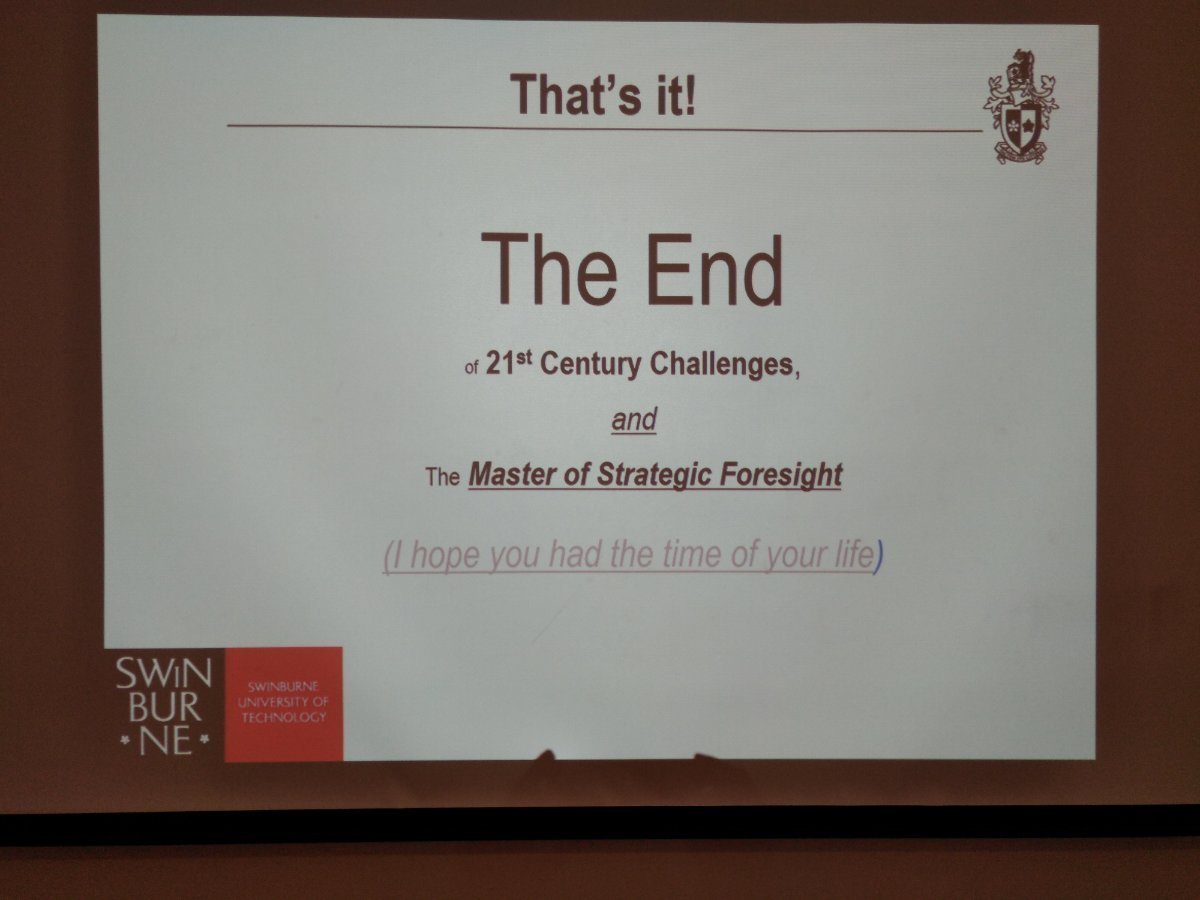
And that’s a wrap! The End of the Swinburne MSF.
Today was the last class ever of the Swinburne MSF (2001 — 2018) — something that has been coming for a long time (announcement of closure was back in May 2016).
There is a KudoBoard where people have posted their memories of the MSF.
Q: What now?
A: Trust emergence…
Celebrating the Master of Strategic Foresight

Last year I noted that the Master of Strategic Foresight (MSF) — with which I’ve been involved since its inception at Swinburne in 2001 and into which I’ve taught for almost as long (through guest lectures firstly, then as a formal member of teaching staff from 2003) — was being shut down, and was to be taught out over the next year or so. My fellow foresight conspirator for much of that time, Peter Hayward (aka “Captain Foresight”), retired at the end of last year, but not before we were able to celebrate the fact that the MSF had existed at all. That was what we chose to call the “MSF Wake”. Continue reading “Celebrating the Master of Strategic Foresight”
Welcome to The Voroscope

On December 21, 2015, a group of graduating students in the Master of Strategic Foresight program that I teach into at Swinburne University presented my colleague Dr Peter Hayward and I with caricatures of our likenesses – Peter was dubbed Captain Foresight, and I was named The Voroscope.
The latter is, of course, a most utterly perfect name for a blog that might seek to examine the whole of the Universe as well as the future, hence the coming-into-being of this blog.
So, welcome to The Voroscope – “an instrument of science and the future,” for examining everything that may exist in the totality of space and time, everywhere and everywhen, from the Hot Big Bang to the Big Chilly Rip, and for examining all manner of potential futures, from the Projected to the Preposterous! – and beyond…
 The Voroscope