
While the process of researching and writing the paper described in the previous post was going on, I was also in contact with another part of the strategic foresight branch at ACT who were beginning to co-organise the second allied foresight conference, thus fulfilling SACT General Lavigne’s wish from the 2024 Helsinki conference for these conferences to become a “tradition”. While that first conference in Helsinki was held in a hotel, which had certain security implications associated with it given the proximity of that city to a fairly staunch NATO adversary, the second one was being planned to be held at NATO Defense College in Rome, which is located inside a military base. Thus, security was going to be both more and less of an issue this time around.
As readers of this blog know, I have been banging on about preposterous futures for around 20 years now, that category having gone into the Futures Cone I was using to teach and do presentations with in around 2006/2007 or so. I had in fact presented the full-strength all-category fully-caffeinated Futures Cone in both presentations in Washington DC and Helsinki. So, it made perfect sense when, in an email in mid-March 2025, as I was working on finalising the initial submission of the future of the rules-based order paper, it was suggested that they would like to get me to Rome to be involved in a session about preposterous futures. But it was also mentioned, in passing, that the rules-based international order might have evolved a bit by then and become an even more prominent topic. How good a futurist that contact was!
That’s why, when the proposed draft agenda came out in late May, there were two slots that caught my eye: a 15-minute TED-style talk first up after the keynotes on the topic of “the next international order”; and another similarly-styled talk later that first morning after coffee on “preposterous futures / the ‘unthought’ futures”. I naturally thought this latter topic was the talk they wanted me to give. But as the program finalised, and logistics began to start being worked out in more detail over the next few weeks, this changed. By around the start of July, some of the conference organisers had obviously read the paper in an advanced draft form, and it was then suggested that I would very likely be leading a TED talk or session on the next international order, and that I should also be available for breakout sessions later to discuss scenarios stemming from the Strategic Foresight Analysis 2025 (SFA25) iteration. The option of being involved somehow with the preposterous futures talk was still kind-of there, but now was seemingly becoming somewhat secondary.
At this stage, I did the Future Force Talk podcast with Gergely Németh, the head of VIKI (and the former branch head of strategic foresight at NATO ACT mentioned in the previous post). So, if you listen to that podcast episode, you’ll hear some discussion about the paper which took place just after I had submitted another advanced draft version, and before it was accepted for final publication. That happened after another round of review and revision in early August and submission in mid-August.
By mid-July it was clear that I would indeed be doing the “the next international order” TED-style talk and helping out on gathering inputs from breakout sessions to feed into the scenarios of the SFA25. By the end of August travel and accommodation was booked and I was gearing up to go to The Eternal City; my first visit there, so I was pretty excited!
In mid-September, I did another interview, this one for The New Abnormal Podcast hosted by Sean Pillot de Chenecey. Again, that episode also mentions the paper as well as the upcoming conference, and the agreement I made with Sean was for the episode to come out a day or two after the presentation in Rome, which was scheduled for the 8th of October.
Rome
I arrived in Rome in the afternoon of the 6th October and had ⅞ of the following day to have a quick look around before the conference ice-breaker on the evening of the 7th. Luckily the conference hotel was only a block away from the Metro, which has a stop next to the Colosseum, and another opposite the Circus Maximus (think of the arena in which the chariot race takes place in Ben Hur. Of course, the arena depicted in Ben Hur is not, nor meant to be, the actual Circus Maximus in Rome, but that depiction gives a sense of the actual structure of the place. The Virtual-Reality headset-based tour you can take of the present archaeological site fills in that detail.)
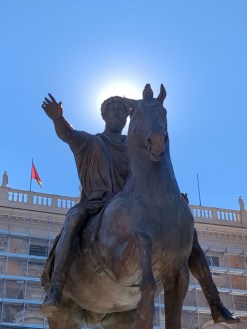
So, I took a look at the Circus Maximus, walking along its length from the Metro station to the river Tiber. Then a walk along the combined pedestrian and bicycle path along the river Tiber (where I found myself at the very spot that Daniel Craig ejects from his spy supercar in the film Spectre); crossing a 1st century BCE bridge (Ponte Fabricio) back towards the Forum; walking past the cliff (Rupe Tarpea) where condemned prisoners were thrown to their deaths; paying my respects to Marcus Aurelius in the Piazza del Campidoglio (see the header image above) before entering the Forum from the north (and far less crowded side) through the airport-style metal detectors; wandering around the Forum for a while (it would take someone a good two days to properly do this); before finally heading to the Colosseum for my scheduled entry. Needless to say, the Colosseum was very crowded, even though they limit how many people can go in and be in it at any time (hence tickets have entry times on them). But, when you think about it, that actually gives a pretty good feel for how it would have been back in the day, since it held something like 70,000 people during an event. The crowds that you have to go through today are a pretty good analogue of the original authentic experience of classical times, although the people who pay extra to end up on the actual arena floor these days are just looking, as opposed to most likely fighting for their lives, sometimes to the death. Frankly, when you think about it, the one place you didn’t want to be, back in the day, was on the arena floor!
That night there was an icebreaker event to welcome us to the conference. Transport was buses from and back to the designated hotel from where we would be taken to the actual conference venue each day. As we boarded the several buses to go to the event, I noticed a half-dozen or so military police (Carabinieri) on motorcycles near us. When we left, they came along! And, in fact, they cleared the traffic ahead of us all the way to the icebreaker event, doing circuits from the last rider behind the last bus, zooming forward at great and noisy speed to ahead of the first bus and halting traffic, all with their lights flashing. This cyclic riding continued for the hour or so it took to reach the venue, through Rome’s notorious (but in this case, somewhat slightly tamed) traffic. It was a very strange experience, to say the least. When it was time to head back to the hotel after the event, we again had this type of escort.
Indeed, on both conference days, we had the Carabinieri escort us to and from the military base which houses the NATO Defense College (NDC). That first morning it was pretty tight security; no USB drives allowed into the base: the presentations had to be emailed ahead of time to be loaded onto the presentation computer in the main lecture theatre. Then the metal detector; but anyone travelling by airplane (or entering the Roman Forum) these days is accustomed to that. In order to even get onto the bus in the first place, we had to be wearing our conference credentials, which were given out at registration in the hotel the previous afternoon as well as that morning. Then meeting up with old friends from NATO who hadn’t been at the icebreaker, and then getting ready to do the preso, which was first up after the welcoming speeches from the Deputy Supreme Allied Commander Transformation (DSACT) and the NDC Commandant. Then there was to be a kind of mind-opening presentation by a philosopher designed, I suspect, to be a bit “out there” so that the possibly-contentious stuff we would be talking about would sound somewhat less contentious by comparison. In fact, I suspect that this might have been a deliberate ploy of “anchoring” using “skilfull means” by the brilliant Florence Gaub, the conference co-organiser and co-host. The fact that he told us he had prepared a talk but had instead decided not to give it and just “vibe present” ex tempore probably played even better into Florence’s no-doubt fiendish plan!
Of course, the paper had not yet been published at this stage, unfortunately, so I did my best to try to pique people’s interest so that when it did come out they would want to read it. There were two more Australians at the conference, both from Defence, and we each wore NATO-Australia friendship lapel pins which one of us had brought. Each of the other two spoke on panels during the conference, so even though Australia is not a formal NATO ally, we nonetheless are part of the so-named Indo-Pacific Four partner nations. Given NATO’s interest in developing out-of-area partnerships, this makes perfect sense. I even mentioned such in the paper.
In the afternoon I was part of several sessions, led by the Action Officer who had helped guide me through the process of getting the paper done, where ideas were gathered to comment upon and augment the findings from the SFA25. That evening I ended up at an invite-only dinner hosted by the NDC Commandant, where I found myself on his table, along with the NATO Chief Scientist, and seated next to the DSACT. It was a slightly surreal and quite memorable experience, to say the least. I am hoping that the “tradition” that former SACT Lavigne hoped for in Helsinki will end up being a regular foresight conference at NDC in Rome. It seems clearly to be the obvious place for it. High security, beautiful city and lovely climate. Only time will tell. But I do, very scientifically, have my fingers crossed…
Budapest
On my arrival back in Australia I heard that the Hungarian Defense Innovation Research Institute (VIKI) was now pulling together the final program for their Technology and Defence 2025 conference to be held in Budapest in early December. People who have listened to the Future Force podcast episode know that I was interviewed by the head of VIKI and have Hungarian heritage, although I was born in Australia. I was going to be the first of the three keynotes following the official opening and speeches on the first morning, the the other two being from the UK MoD and the OECD respectively. Our talks formed a logical sequence. I spoke about the international order (again), making the paper available to the conference organisers to distribute (albeit with an emphasis on the need for innovation in the changing world order), while the other two narrowed down the broad view to more focused perspectives to within the Defence innovation sector as well as considering how to fund this activity. The order and flow was actually pretty well designed. There was apparently a bit of a kerfuffle about a certain foreign ambassador attempting to enter the venue without an invitation or credential, but I’ll leave it to those who might be interested in such things to search for reports of this (mostly in Hungarian 😉).
I did also manage to visit and catch up with relatives, as well as to scatter my father’s ashes into the Danube one night practically in the shadow of the Freedom/Liberty Bridge, a promise I had made to him more than two decades earlier. He had been in the Hungarian Revolution in 1956 and had had to escape the retribution that was meted out afterwards when it was ultimately crushed by the tanks that rolled in. This is how he ended up in Australia, where he met my mother, who had herself escaped years earlier. He was for this reason not able to return with mum and I when we visited relatives on several occasions in my youth, before the Rendszer Változás (System or Regime Change) in 1989 and, by the time he could have, he was too unwell to travel. I am forever grateful to the Director of VIKI, Gergely, for inviting me to present at that conference and therefore affording me the opportunity to finally fulfill a promise I had made long ago…
To round this out, I’ll mention that I was invited by Dr Chris Jones to (again) present on the future of the rules-based order, this time online in March 2026 to the Post-Normal Times symposium group, which is part of the Center for Post-Normal Policy and Futures Studies. I know a few of the people working there, so it was kind of fun to get a chance to go full-on futurist to a group that really groks what we are trying to do with strategic foresight. Needless to say I was challenged on several aspects of the paper by a few of the participants, but that is part and parcel of the dialectical mode of inquiry that is central to critical future studies (Voros 2008).
And that seems to have brought to an end this particular career episode of foresight work.
Semi-retirement projects
When I was made redundant during the Covid pandemic back in 2020, which coincided with some health issues I ended up experiencing, I can remember wondering in the aftermath what I would then do in my work, and whether I needed to consider some “semi-retirement projects” to keep my mind active. I remember thinking about trying to expand the scope of the Defence work I had by then been doing for about a year or so beforehand, even wondering about whether it might be possible to eventually manage to do so at the international level. I now look back and see that that image of the future guided many of my later decisions and has ended up actually “coming true” (so to speak). Such is the power of the image of the future. Now it seems time to activate another such image.
For some years now I have joked with people that in my semi-retirement I have two main projects, depending on my whichever identity I choose to inhabit: one as a physicist and the other as a futurist. As a futurist, it is (ahem!) to try to help save the world. (I know, right?) But, such has been the underlying rationale for consulting to NATO. The other semi-retirement project stems from my earlier training (and first love): physics. And as a physicist, I am interested in trying to “reverse-engineer” quantum mechanics. This means, essentially, trying to make sense of the mind-fracking weirdness that is quantum mechanics. So, two main projects to exercise the semi-retired mind: try to save the world, or reverse-engineer quantum mechanics. It is left as an exercise to the reader which of these is more likely to succeed… 😁 The last two posts have described the first of these projects. The next post will introduce the second one.
References
Voros, Joseph. 2008. “Integral Futures: An Approach to Futures Inquiry.” Futures, Integral Futures, vol. 40 (2): 190–201. https://doi.org/10.1016/j.futures.2007.11.010.
Image credit: The author.
 The Voroscope