National Security Podcast episode – Mapping the Future

A few weeks ago I was in Canberra to teach into the Advanced Futures course run by the Futures Hub at the National Security College (NSC), which is part of a joint initiative between the Australian Commonwealth Government and The Australian National University (ANU).

This was my third trip to NSC, so – according to the Goldfinger Principle – this now constitutes “enemy action” 😉

I taught into the opening morning session and, later that afternoon, took part in recording an episode for the National Security Podcast. The two other guests were Dr Ryan Young, the Director of Research & Methods at the Futures Hub, and Odette Meli, a fellow member of the NSC’s Futures Council. We were hosted by Dayle Stanley, the Director of Strategy & Engagement for NSC. The topic was: “Mapping the future: how strategic foresight can supercharge policymaking.”

It was a wide-ranging discussion, covering a lot of territory, and was focused primarily on helping people who may not be familiar with futures analysis understand how futures can be useful in their strategic,  policy and decision-making contexts. We were asked to give concrete examples of how our work has been useful, and it was very interesting to hear the other guests’ experiences – very often we carry out our foresight engagements in isolation from other practitioners, so hearing from others about their work is always fascinating and valuable.

As ever, I hope it is both interesting and useful.

https://play.acast.com/s/the-national-security-podcast/mapping-the-future/

AusCERT Podcast interview – What Does The Future Hold?

While at the AusCERT Conference back in May, I recorded a podcast interview with my old friend, tech aficionado and general tech fan-boy all-rounder Anthony Caruana. We’ve known each other for nearly 30 years, and our paths have criss-crossed many times over the course of our careers, so it was kind of fun to catch up once again for a chat.

As you might imagine, Anthony and I did a fair bit of reminiscing before the microphone went live, some of which is made reference to (but a lot is not!). The interview was recorded over lunch a couple of hours before my keynote preso later that afternoon, and actually went on for much longer, too, but the miracle of editing (and AI-powered software?) makes both of us sound fairly eloquent. It’s now published on the AusCERT web site as well as via the usual suspects channels. AusCERT call their podcast “Share Today, Save Tomorrow”, and this episode – number 25 – is entitled What Does the Future Hold?

As ever, I hope it is both interesting and useful.

https://auscert.org.au/podcast/podcast-ep-25-what-does-the-future-hold/

Exponential Minds Podcast interview

Nikolas Badminton of the Exponential Minds Podcast and I had a chat a couple of months ago. That interview is now live.

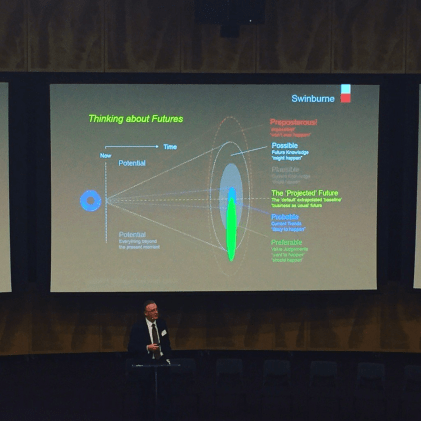
We had a pretty fun conversation. It did meander just a teeny little bit, but it does manage to mention quite a few things as a result: something of the history of my use of the Futures Cone; the levels at which foresight can be implemented; Big History and how I’ve used it to frame the coming civilisational energy transition (i.e., away from fossil fuels); as well as mention of David Christian‘s new book which continues on from Origin Story (which I was reading in manuscript at the time). Of course, there are also some aliens mentioned in there, as is Hoag’s Object. There’s also a little bit on this blog’s current scanning retrospective and the concept of futures intelligence. So, all in all, regular readers won’t find too much that is unfamiliar in the interview, but it might be fun to hear it spoken of. Nikolas did a pretty good job of paring it all back from the very long chat we had! 😉

What I am smiting my forehead over, though, is that I forgot to mention Cal Newport’s 2019 book Digital Minimalism, during the segment where we were talking about using technology with careful intention. My bad! Also, Newport’s podcast, whose name I couldn’t quite remember, is Deep Questions, and it just keeps getting better and better as Cal hits his stride with it. It’s definitely re-ignited my interest in intentional approaches to productivity. Might end up doing a series of posts on that, one of these years…

Anyway, I do hope you enjoy listening to the interview as much I did recording it! Thanks Nikolas!

The Interview:
at Exponential Minds
on YouTube

Is ‘Hoag’s Object’ an ‘engineered’ galaxy?

The question asked in the title of this post is one I have been pondering for the most part of a decade now, ever since I saw the image, shown in Figure 1, of the galaxy PGC54559 (popularly known as Hoag’s Object) in 2010, following several months of thinking about what Kardashev Type III civilisations might look like.

hoag_hst_big_full
Figure 1. PGC54559 (‘Hoag’s Object’). Image credit: NASA & The Hubble Heritage Team (STScI/AURA). Acknowledgement: Ray A. Lucas (STScI/AURA). Multiple formats and sizes are available from: http://hubblesite.org/image/1241/news_release/2002-21

Continue reading “Is ‘Hoag’s Object’ an ‘engineered’ galaxy?”

Quo vadis Humanity?

I mentioned last year that I had made a presentation at the Big History Anthropocene conference held in December 2015 at Macquarie University and organised by the Big History Institute. The presentations from that conference can be viewed on YouTube, with the full playlist available at this URL. They are almost universally terrific — it was one of the most engagingly informative conferences I’ve been to, so I encourage you to dip into the playlist. Continue reading “Quo vadis Humanity?”

On examining Preposterous! futures

In my futures work, I use a cone diagram (above,* and again below**) to show how our judgements about ideas about the future tend to fall into a number of categories: Continue reading “On examining Preposterous! futures”