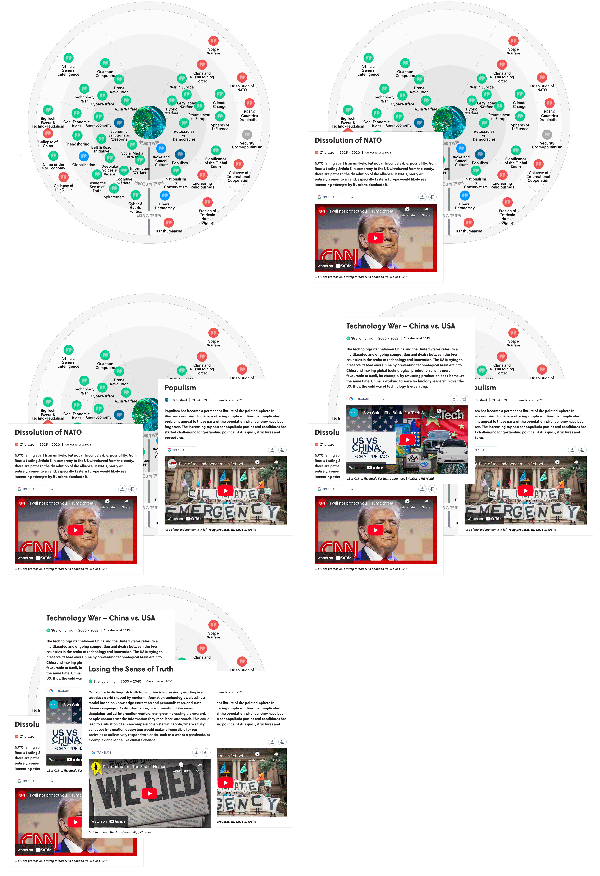
Of things NATO, 1: The future of the rules-based international order

Animated radar by Futures Platform of the FRBIO

I mentioned a while ago that I was working on a paper on the not-at-all scary little topic of “the future of the rules-based international order”, having been commissioned by NATO to write it. Well, it was finally published online in early November last year, having been submitted just before Easter (ie early April). The full reference with link is given below. Here I want to describe something of the background to the paper as well as the process of getting it to print, which took about 18 months from the initial email canvassing the idea to the final version appearing on the internet. Much of this post was written late last year and only very recently completed.

Continue reading “Of things NATO, 1: The future of the rules-based international order”

The New Abnormal podcast episode

After the Future Force Talk podcast episode, I did an interview on The New Abnormal podcast hosted by Sean Pillot de Chenecey. It was recorded a couple of weeks before a presentation I was to give at a NATO conference in Rome last October. I will describe the lead-up to that presentation, and the paper it was based upon, in a subsequent post.

Continue reading “The New Abnormal podcast episode”

Future Force Talk podcast episode

I recently did a podcast interview on the Future Force Talk podcast, which is hosted by the Hungarian Defence Ministry’s Defence Innovation Research Institute (in Hungarian: Védelmi Innovációs Kutató Intézet, which has the wonderful acronym VIKI). The podcast host is Dr Gergely Németh, the Director of VIKI, who was formerly the Branch Head of the Strategic Foresight Branch at NATO’s Allied Command Transformation.

Continue reading “Future Force Talk podcast episode”

Two recent activities – a podcast and a presentation

I see that it has been quite a while since I posted here. This is mainly because for the past year or so, and most especially the last six months, I have been immersed up to my eyelobes [sic] in the International Relations literature working on a thematic paper on the future of the rules-based international order. I’ll delay any further discussion about this until the paper is published and then reflect on what that was like. But you can probably guess from the previous blog entry who this was for…
Continue reading “Two recent activities – a podcast and a presentation”

NATO’s First Allied Foresight Conference

Last week, I was invited to attend and present at the First Allied Foresight Conference, organised by NATO’s Allied Command Transformation in conjunction with the Finnish Ministry of Defence. This follows a very successful Foresight Symposium held in Washington DC around this time last year.

Continue reading “NATO’s First Allied Foresight Conference”

NATO’s Strategic Foresight Analysis 2023

Last year I contributed to the development of the Strategic Foresight Analysis 2023 (SFA23), undertaken by the Strategic Foresight Branch of NATO’s Allied Command Transformation. This was a more-than-year-long effort combining the expertise of some 800 workshop participants, together with the experience of around 20 or so members of a core reference team who got to see, comment upon, and make suggestions for inclusion into, earlier draft versions of the Report (see page 98 of the SFA23 to see their names). It was amazing to see the document take shape over that time.
Continue reading “NATO’s Strategic Foresight Analysis 2023”

Scanning hits over at LinkedIn

In the spirit of the Scanning Retrospective, I now publish some of my scanning hits over at LinkedIn, on a dedicated page called, of course (what else?), TheVoroscope. I typically post only 2-3 per week, and then only if they are something that catches my eye, so if you look through the hits from the Scanning Retrospective and you find them interesting or quirky enough, or they seem to resonate for you, you might want to consider “following” TheVoroscope page over at LinkedIn.

https://www.linkedin.com/company/thevoroscope/


National Security Podcast episode – Mapping the Future

A few weeks ago I was in Canberra to teach into the Advanced Futures course run by the Futures Hub at the National Security College (NSC), which is part of a joint initiative between the Australian Commonwealth Government and The Australian National University (ANU).

This was my third trip to NSC, so – according to the Goldfinger Principle – this now constitutes “enemy action” 😉

I taught into the opening morning session and, later that afternoon, took part in recording an episode for the National Security Podcast. The two other guests were Dr Ryan Young, the Director of Research & Methods at the Futures Hub, and Odette Meli, a fellow member of the NSC’s Futures Council. We were hosted by Dayle Stanley, the Director of Strategy & Engagement for NSC. The topic was: “Mapping the future: how strategic foresight can supercharge policymaking.”

It was a wide-ranging discussion, covering a lot of territory, and was focused primarily on helping people who may not be familiar with futures analysis understand how futures can be useful in their strategic,  policy and decision-making contexts. We were asked to give concrete examples of how our work has been useful, and it was very interesting to hear the other guests’ experiences – very often we carry out our foresight engagements in isolation from other practitioners, so hearing from others about their work is always fascinating and valuable.

As ever, I hope it is both interesting and useful.

https://play.acast.com/s/the-national-security-podcast/mapping-the-future/

AusCERT Podcast interview – What Does The Future Hold?

While at the AusCERT Conference back in May, I recorded a podcast interview with my old friend, tech aficionado and general tech fan-boy all-rounder Anthony Caruana. We’ve known each other for nearly 30 years, and our paths have criss-crossed many times over the course of our careers, so it was kind of fun to catch up once again for a chat.

As you might imagine, Anthony and I did a fair bit of reminiscing before the microphone went live, some of which is made reference to (but a lot is not!). The interview was recorded over lunch a couple of hours before my keynote preso later that afternoon, and actually went on for much longer, too, but the miracle of editing (and AI-powered software?) makes both of us sound fairly eloquent. It’s now published on the AusCERT web site as well as via the usual suspects channels. AusCERT call their podcast “Share Today, Save Tomorrow”, and this episode – number 25 – is entitled What Does the Future Hold?

As ever, I hope it is both interesting and useful.

https://auscert.org.au/podcast/podcast-ep-25-what-does-the-future-hold/

Podcast for Inquiry interview

I recently recorded a podcast episode with Leslie Rosenblood of the Centre for Inquiry Canada, which produces the (aptly-named) Podcast for Inquiry.

Leslie has a wonderful ability to take conversations in new directions on the spur-of-the-moment. You can hear this in his other interviews, and in the way this one branched out several times. And also in how it tried to finish but couldn’t quite do so, the first time, no doubt due to my worrying that I had forgotten something I’d meant to speak about (the Sept 11 story).

Anyway, it was fun to do, and I hope that readers of this blog might find it useful. Sometimes it is much easier to hear someone speak about their subject than to simply read it. I hope you enjoy it.

https://centreforinquiry.ca/futures-studies-with-joseph-voros/

Scanning Retrospective, No. 36

‘From the pages of prospect’ – No. 11

[Originally published] Issue 10, December 2002

    • [Intro to new format for prospect]
    • [Description of selection criteria for inclusion of items (‘hits’) in the  FPR strategic scanning database (SSD)]
    • [Sign-off from FPR, editorship of prospect and authorship of the Snippets]
    • [Ten scanning ‘hits’ from the SSD]
    • Foresight Snippets, No. 25

Continue reading “Scanning Retrospective, No. 36”

Scanning Retrospective, No. 35

‘From the pages of prospect’ – No. 10

[Originally published] Issue 9, September 2002
Special Issue – Environmental Scanning

  • Environmental scanning
  • Environmental scanning in four worlds
  • Reframing environmental scanning
  • Foresight Snippets, No. 24

Continue reading “Scanning Retrospective, No. 35”

Scanning Retrospective, No. 34

‘From the pages of prospect’ – No. 9

[Originally published] Issue 8, June 2002

  • Virtual schools
  • The radical restructuring of higher education
  • A choice of transformations for the 21st-Century university
  • Foresight Snippets, No. 23

Continue reading “Scanning Retrospective, No. 34”

Scanning Retrospective, No. 33

‘From the pages of prospect’ – No. 8

[Originally published] Issue 7, March 2002

  • From The Herman Trend Alert:
    • Metamorphosis of University Education
    • Internationalisation of Education
    • Upheaval in Education?
  • The Futures of Universities
  • Higher Education in the 21st Century
  • Foresight Snippets, No. 22

Continue reading “Scanning Retrospective, No. 33”

Scanning Retrospective, No. 32

‘From the pages of prospect’ – No. 7

[Originally published] Issue 6, December 2001
Special Issue – Preparing for the Swinburne Scenarios Project, 2002

  • A Primer on Futures Studies, Foresight and the Use of Scenarios
  • Envisioning (and Inventing) the Future
  • Making the Future Visible: Psychology, Scenarios and Strategy
  • From Scenario Thinking to Strategic Action
  • The Swinburne Scenarios Project 2002

Continue reading “Scanning Retrospective, No. 32”

Scanning Retrospective, No. 31

‘From the pages of prospect’ – No. 6

[Originally published] Issue 5, September 2001

  • The Inevitability of a Business Model for Higher Education
  • Trends Transforming the Universities of This Century
  • Managerial Vision
  • The Notion of Entrepreneurship: Historical and Emerging Issues

Continue reading “Scanning Retrospective, No. 31”

‘Timing’ of scanning systems

The final major piece of the scanning puzzle is the issue of timing: how often, or according to what sort of timetable, is the scanning in your organisation to be carried out? That question depends on how aware you want to be about what is going on in the external environment, and what your tolerance is for the risk of being blindsided out of existence by events or emerging issues in that environment. (TL;DR: serious preparation requires serious resourcing of the scanning system; no shortcuts or excuses will cut it. Reality cannot be fooled.)

Continue reading “‘Timing’ of scanning systems”

Scanning Retrospective, No. 30

‘From the pages of prospect’ – No. 5

[Originally published] Issue 4, June 2001

  • Linking Strategic Thinking with Strategic Planning
  • Changing Ideas of the University
  • Bridging the Divide
  • Trend Alert: Recruiters Will Reach Into High Schools

Continue reading “Scanning Retrospective, No. 30”

Scanning Retrospective, No. 29

‘From the pages of prospect’ – No. 4

[Originally published] Issue 3, March 2001

  • Education: New Economy, New Challenges?
  • Reshaping Universities for the Future
  • Universal Tertiary Education
  • Academic Entrepreneurship in Higher Education

Continue reading “Scanning Retrospective, No. 29”

Scanning Retrospective, No. 28

‘From the pages of prospect’ – No. 3

[Originally published] Issue 2, Dec 2000

  • Instititutional Entrepreneurship in Higher Education
  • The Changing Research Environment
  • Globalisation: a world without borders
  • TAFE and university graduates – what’s the difference?

Continue reading “Scanning Retrospective, No. 28”